Hans Rottenhammer
Munich 1564 (?) – 1625 Augsburg
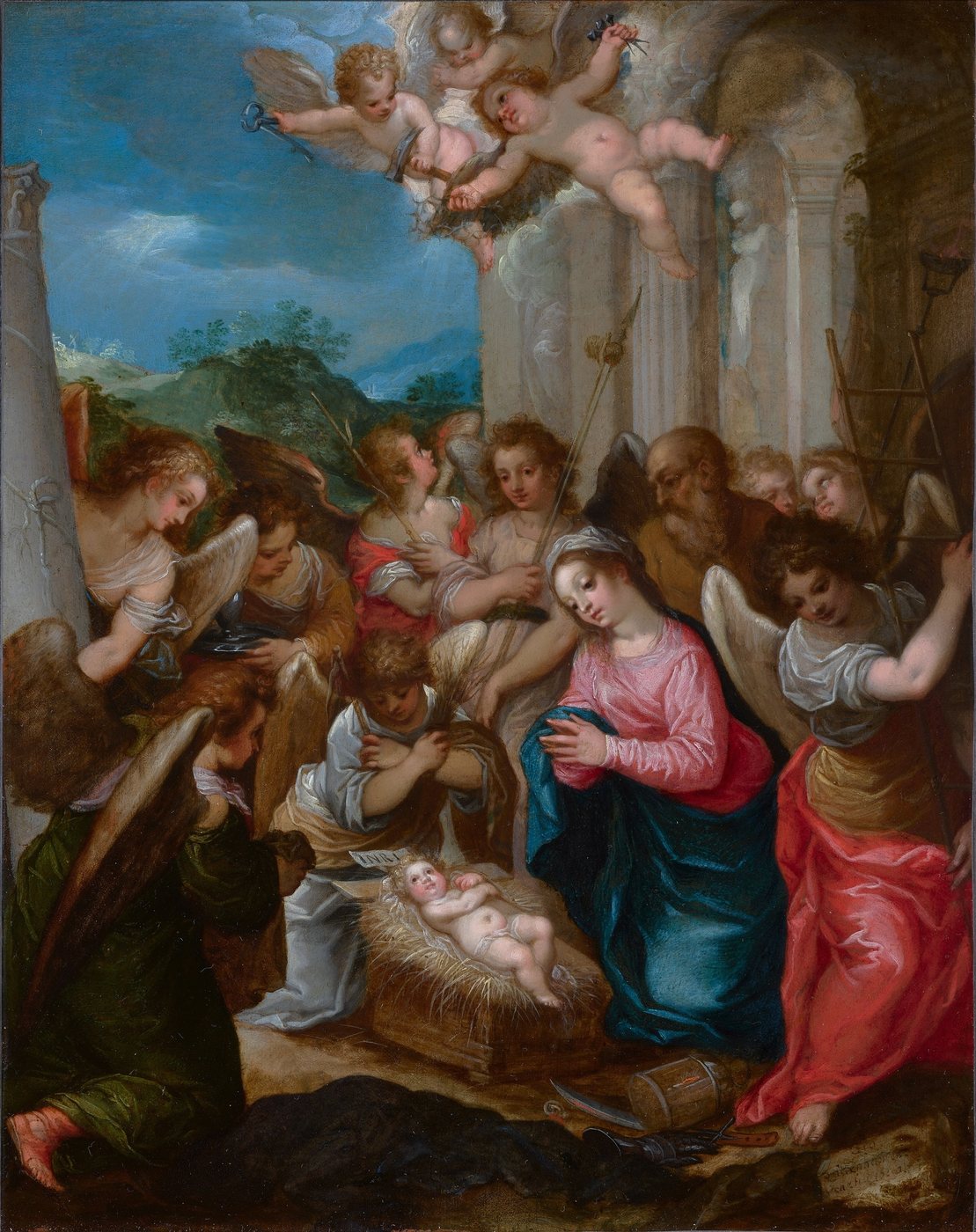
The Adoration of the Christ Child with Angels Carrying the Arma Christi
- Signed lower right: Gio. / Rottenhamer / Venetia 1601
- Oil on copper
- 26.5 × 21 cm
His residence in Venice proved quintessential for Rottenhammer, whose previous Munich court contacts provided him with recommendations and access to the city’s high-end German collectors’ circles. Taking in the art of Titian and other Venetian artists such as Tintoretto (1518-1594), Veronese (1528-1588), the Bassani and Palma il Giovane (1548/50-1626), Rottenhammer specialised in delicate history paintings – often Biblical narratives – inspired by the Venetian masters’ output, yet in a personal style, often on small format, the most beautiful of them painted on copper support, allowing for the most delicate painterly effect, and exquisitely suitable for personal devotion.
The present, newly resurfaced painting is precisely such a gem. Executed in Venice in 1601 – and not in the 1590s, as was previously assumed – the work is a marvel of finesse and intimacy, in which Rottenhammer shows all his capabilities in the rendering of flesh tones, coloristic nuances, atmospheric perspective, and the expression of both tenderness and emotional depth. In a landscape, against the immediate background of an antique columnated edifice, the Virgin Mary and Joseph, joined by nine angels, are grouped around the Christ Child, who lies in a crib, embracing a wooden cross with a banner carrying the initials INRI. Hovering above are three putti. Both the putti and the angels carry objects that specifically relate to Christ’s future crucifixion, the so-called Arma Christi, or Instruments of the Passion of Christ.
Rottenhammer’s composition proved to be hugely popular. No less than eight versions – all unsigned – have come down to us, of which several might originate from Rottenhammer’s workshop, while others were presumably executed by other artists. A precious silver relief depicting the composition with minimal alterations, kept at the Kunsthistorisches Museum in Vienna, is signed by the goldsmiths Christoph Lencker (c. 1556-1613) and his son Zacharias Lencker (d. 1612) and dated 1609.
Provenance
- South Germany, private collection
Literature
- H. Schlichtenmaier, Studien zum Werk Hans Rottenhammers des Älteren (1564–1625), Maler und Zeichner : mit Werkkatalog, diss. Tübingen, Eberhard Karls Universität Tübingen 1988, pp. 109-110, 219, cat. no. G I 20
- M. Fahn, ‘Das Wiener Anbetungsrelief – ein Werk von Christoph und Zacharias Lencker’, in: R. Eikelmann, A. Schommers, L. Seelig (eds.), Studien zur europäischen Goldschmiedekunst des 14. bis 20. Jahrhunderts : Festschrift für Helmut Seling zum 80. Geburtstag am 12. Februar 2001, Munich 2001, pp. 39-50, pp. 40, 45-46, fig. 2
- M. Bisschoff, in: H. Borggrefe, M. Bisschoff, T. Fusenig, Hans Rottenhammer : begehrt, vergessen, neu entdeckt, exh. cat. Lemgo, Weserrenaissance-Museum Schloss Brake, Prague, Národní Galerie v Praze 2008-2009, pp. 66, 170, under cat. no. 77