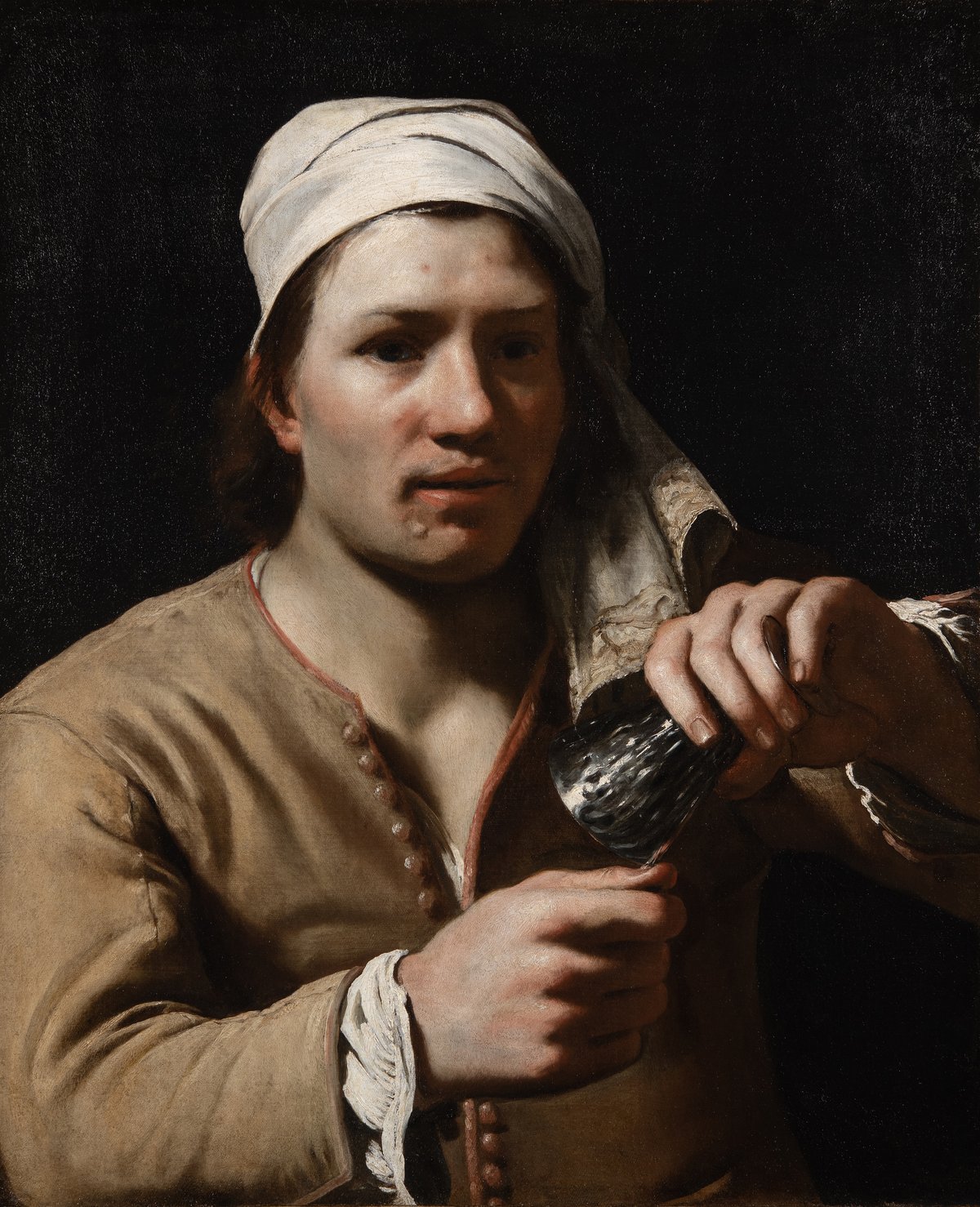
Michael Sweerts
Brussels 1618 – 1664 Goa
A Young Man Wearing a Turban Holding an Upturned Glass: The Fingernail Test (Allegory of Taste)
- Oil on canvas
- 75 × 58.4 cm
A new addition to Sweerts’ oeuvre
The present work, a monumental bust of a young man holding a glass, first surfaced in a London auction in December 1995, understandably too late for its inclusion in Rolf Kultzen’s monograph on Sweerts, which was published in 1996. Set against a near black background, our painting depicts a young dark-haired man, presumably about 30 years old, with a light skin, a firm nose and dark eyes, full red lips, and a mole on his chin. He is dressed in a white headscarf with embroidered border and a white chemise underneath a simple, collarless, ochre and red-rimmed buttoned jacket. As he looks at the beholder with a sympathetic demeanour, he holds in his left hand a fine, greenish façon de Venise wine glass – upside down, its rim on the nail of his right-hand thumb. Sweerts painted the work with much vigour, expertly alternating smoother passages such as the fabric of the jacket with bold impasto brushwork, especially in the incarnate, the spectacular cuffs and the well struck glass.
During festivities, or when making a toast to a host or a guest, one would customarily drink down a glass of red wine in one gulp, pouring the very last red droplet (resembling a ruby) on one’s thumbnail, and then lick it as a sign of respect and homage to the person being celebrated. The expression ‘faire rubis sur l’ongle’ (to make a ruby on the nail) was thus used to indicate that the glass had been completely emptied.
One of Sweerts’ most iconic paintings, the Boy in a Turban Holding a Nosegay in the Museo Thyssen-Bornemisza in Madrid, has been interpreted as depicting the sense of smell ever since its surfacing in 1955. Not only do these two works combine very well compositionally and colour-wise, but both are also thematically proper and conceptually matching representations of the senses (Smell and Taste) and – crucially – both share equal measurements. In summary, there is strong evidence in favour of the two works having originally belonged to the same series. Scholarly consensus nowadays places the Madrid painting unequivocally in Sweerts’ post-Italian years; the same dating, c. 1656/60, must likewise be applied to our work.
Provenance
- Berne, Dr. Bruno Kaiser (1877–1941)
- By inheritance, 1941, to a private collection, for two generations
- By whom sold, London, Christie’s, 8 December 1995, lot 34, where acquired by
- Monaco, collection Emanuel Wolfe (Manny) Davidson (1931-2024)
- His estate sale, Paris, Sotheby’s, 5 November 2025, lot 48
Literature
- W. Liedtke, Dutch Paintings in the Metropolitan Museum of Art, 2 vols., New York 2006, 1, pp. 269-270, under cat. no. 61, note 11
- L. Shaw-Miller, ‘‘Beautiful Secrets’: Poetical Disclosure in the Work of Michael Sweerts’, in: M. McNeill Hale (ed.), Cambridge and the study of Netherlandish art : the Low Countries and the Fens, Turnhout 2016, pp. 124-137, pp. 128, 130, fig. 5