Michael Sweerts
Brussels 1618 – 1664 Goa
The Virgin at Prayer with Self-Portrait
- c. 1650–1651
- Oil on canvas
- 45.1 × 34.3 cm
- A label with handwritten inv. no. 167 (or 164?) on the reverse
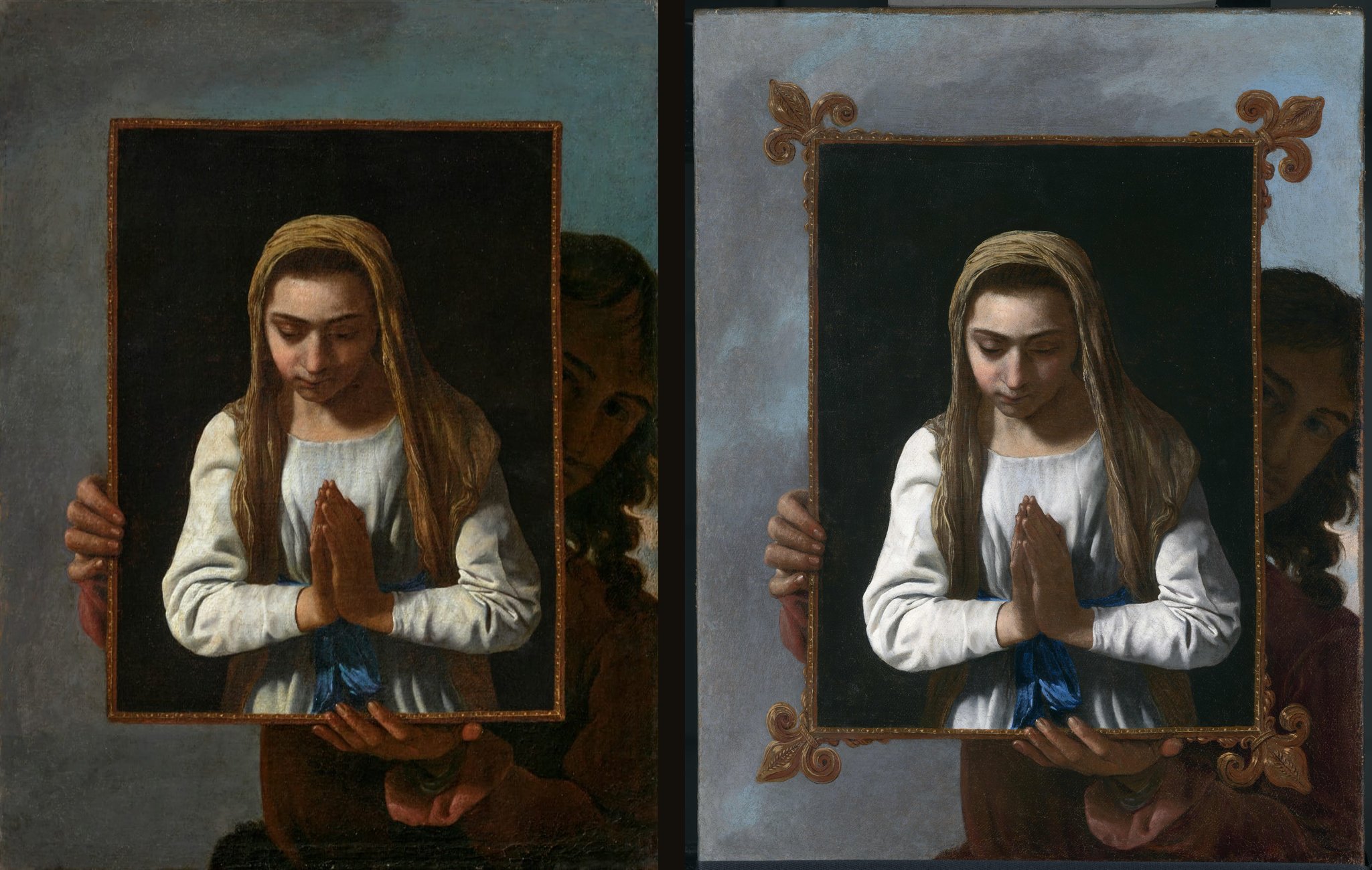
- Illustrated before (left) and after (right) restoration
A frame rediscovered
This remarkably original composition, unpublished and known only through archival sources until its appearance at auction in 2023, represents a significant discovery within Sweerts’ oeuvre. It blends religious devotion with personal introspection: the artist, wearing a red velvet doublet, holds up a painting of the Virgin at prayer and peers out at the viewer from behind it, as if in her shadow. Painted in Rome around 1650–1651, when Sweerts worked for Prince Camillo Pamphili and was knighted in the Order of the Golden Spur by Pope Innocent X, it is one of the very few religious subjects in his work.
Before its recent restoration, the appearance of this painting was profoundly misleading. Later overpaint, applied with a wide brush, covered up to sixty per cent of the surface: two layers of modern blue and grey paint concealed the original background and sky, and the whole was marred by uneven, discoloured varnish.
Infrared reflectography and raking light revealed what lay beneath: the fleur-de-lis finials of an ornamental, Italianate frame that Sweerts himself had painted around the image of the Virgin. The overpaint appears to have been deliberately extended to hide these corner ornaments, giving the painted frame a sleek outline quite foreign to the artist’s intention. Removed patiently under the microscope by the conservation studio Redivivus in The Hague, it gave way to the frame ornaments, a brighter sky and background, and the rich original glazes of the red robe.
The face of the young man holding up the picture – the artist’s self-portrait – had previously been retouched only superficially, and the outline of his hair and head had been extended with overpaint. The restoration has returned the work to the appearance Sweerts intended: a painting within a painting, presented to the viewer in its own illusionistic frame.
Provenance
- Possibly London, collection William van Huls (after 1649–1722)
- Possibly his deceased sale, London, 5 August 1722, lot 1661
- Possibly Haarlem, collection François Constantijn Druyvesteyn (1729–1767)
- His deceased sale, Haarlem, Jelgersma and Van der Vinne, 26 April 1768 (Lugt no. 1678)
- Austria, private collection, since at least the first half of the twentieth century, by inheritance until 2023
- Sale London, Christie’s, 7 December 2023, lot 10
Literature
- Possibly R. Kultzen, Michael Sweerts: Brussels 1618 – Goa 1664, Ghent 1996, p. 144, cat. no. 11 (‘Lost pictures / Pictures known only from sales and inventories’), with reference to the Druyvesteyn sale, 1768