Pieter Claesz
Berchem near Antwerp, c. 1597 – 1660 Haarlem
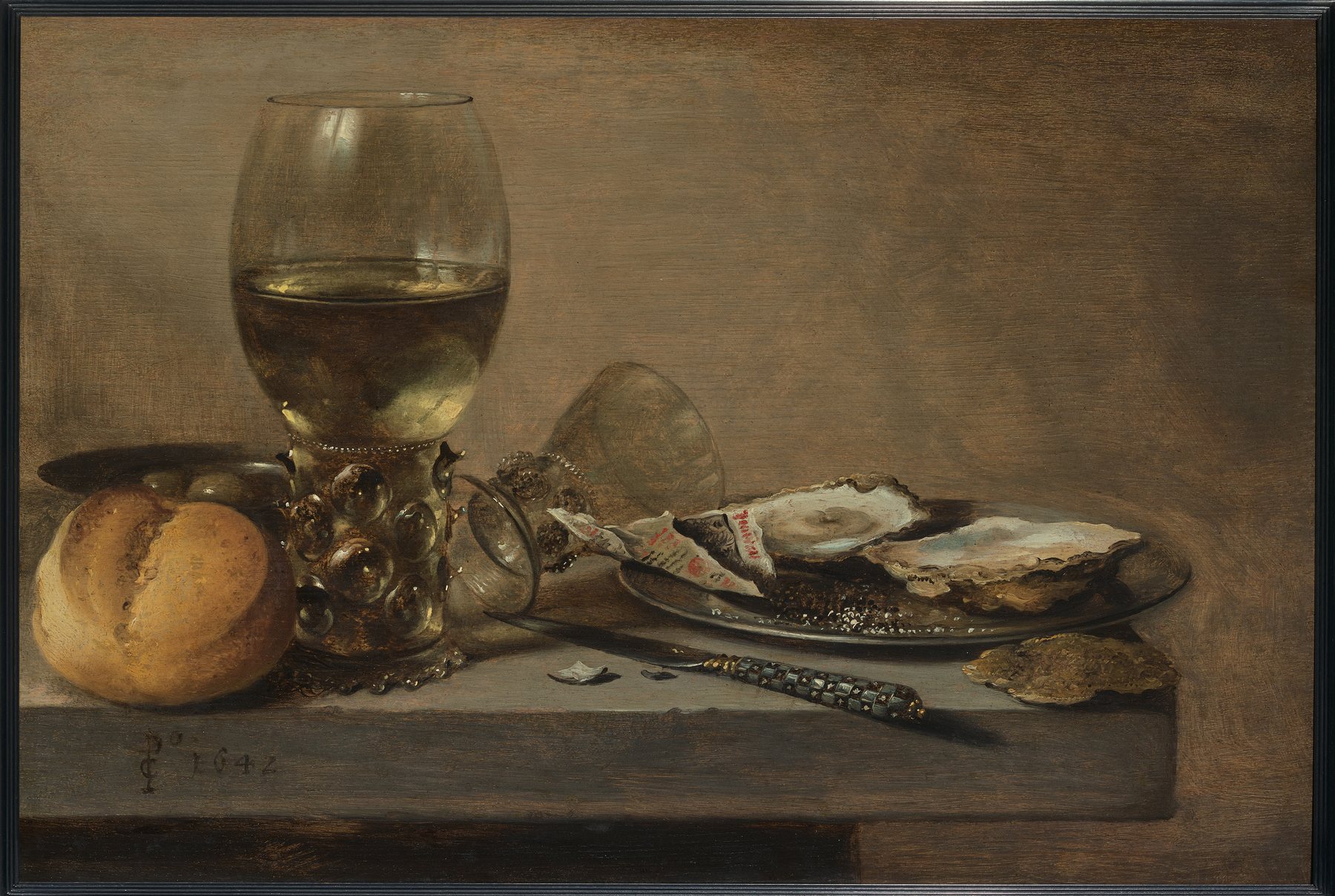
Still Life with a Bread Roll, a Roemer and a Lying Berkemeyer, a Plate of Olives, a Knife, Oysters with Pepper and Salt on a Pewter Dish atop a Table
- Signed with monogram and dated lower left: PC 1642
- Oil on panel
- 37.1 × 51.3 cm
In the first half of the seventeenth century, Pieter Claesz was Haarlem’s most renowned still life painter. He was born in Berchem, near Antwerp, around 1597, and roughly in 1621 moved from the Southern Netherlands to the prosperous Haarlem. Claesz limited his use of objects and colour to develop his own style of still life: the monochrome banketje. He masterfully rendered materials such as silver and gold, pewter, ceramic, glass and various different foods, which he illuminated with an invisible source of bright light. Inventories of seventeenth-century Haarlem collections reveal Pieter Claesz as the most represented still life painter in the city. After a forty-year long career, he died in 1660 at 63, leaving an oeuvre of roughly 260 still lifes.
Bright light flows in from the upper left and rests on all of the objects. The eye goes immediately to the big, crunchy bread roll on the left side of the table, illuminated by the warm mid-day light. On the right of the bread, an olive green Roemer filled with white wine dominates the composition. To the right of the Roemer, a smaller cone-shaped glass, a Berkemeyer, lies on its side giving the composition a strong diagonal pull. A large shiny plate with two oysters and a crumpled sheet from an almanac sits in front of the Berkemeyer, while the table knife with a precious mother-of-pearl patterned handle, one of the artist’s favourite motifs, cuts across the table and compellingly invites the viewer to take part in this intimate meal.
In the ontbijtje dated 1642 here presented, we see the painter at the height of his mastery. Each object is impeccably placed within the composition. This painting belongs to a group of still lifes from the early 1640s that is characterized by the artist’s careful trimming of objects, ultimately culminating in a single free-standing monumental Roemer. Pieter Claesz pays here particular attention to the oysters, the perfect subject to suit his preference for a colour palette of chromatic minimalism, as they are symbols of status and wealth. He chooses not a “modest message” in his motifs and treatment of the paint, but rather gives us the perfect expression of refined artistic reflection. — Martina Brunner-Bulst
Provenance
- Sale London, Christie’s, 8 October 1976, lot 16
- London, Alfred Brod Gallery, by 1977
- United States, Mr. and Mrs. J. Seward Johnson
- Sale New York, Sotheby’s, 8 January 1981, lot 9
- Sale New York, Christie’s, 15 January 1985, lot 36
- Private collection
Literature
- Advertisement Brod Gallery, in: Apollo 105 (May 1977), p. 400, ill.
- Advertisement Brod Gallery, in: Die Weltkunst 47 (June 1977), p. 1147, ill.
- N.R.A. Vroom, A modest message as intimated by the painters of the ‘Monochrome Banketje’, 2 vols., Schiedam 1980, 1, p. 155; 2, p. 51, no. 242, ill.
- N.R.A. Vroom, A modest message as intimated by the painters of the ‘Monochrome Banketje’, Nuremberg 1999 (vol. 3 of Vroom 1980), p. 63, fig. 51, p. 81 (as Franchoys Elout)
Exhibited
- Maastricht, Pictura, European Fine Art Fair, May 1977 (Brod Gallery London)