Salomon van Ruysdael
Naarden c. 1600/03 – 1670 Haarlem
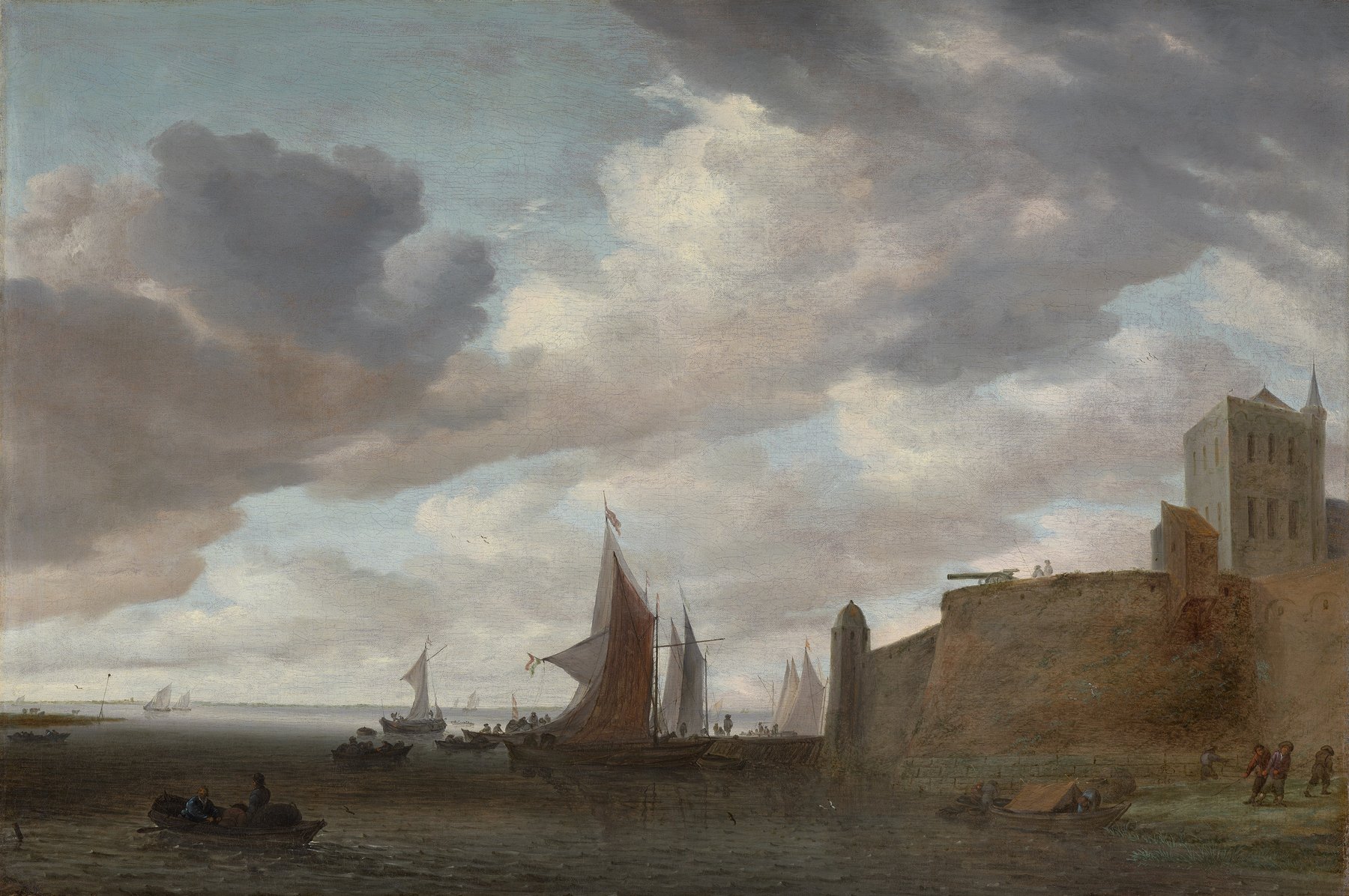
A River View with a Bastion, Fishermen and Shipping
- Signed and dated lower right: SvR 1645
- Oil on canvas
- 74 × 109 cm
Salomon was the son of the Mennonite cabinetmaker Jacob Jansz de Goyer (c. 1560–1616) from Naarden. Shortly after his father’s death, Ruysdael and his brother Isack – the father of the famous landscape painter Jacob van Ruisdael (1628/29–1682) – moved to Haarlem, where Salomon entered the Guild of St Luke in 1623 under the name Salomon de Gooyer. Shortly thereafter he adopted the name Ruysdael from the castle of that name in the Gooiland, which may once have been a family possession.
His first dated picture is from 1626, soon followed by three winter scenes from 1627. While first adhering to the new, realistic landscape style of Esaias van de Velde (1587–1630), Salomon quickly elaborated his manner and, together with Jan van Goyen (1596–1656) and Pieter de Molyn (1595–1661), created a distinctive landscape art depicting the environs of Haarlem, applying a restricted tonal range and modest subject matter. Over the next three decades he established himself as a well-to-do Haarlem citizen and a prolific and successful painter, with pupils including his son Jacob, his nephew Jacob van Ruisdael and Cornelis Decker. Van Ruysdael is above all known as one of the ‘classic’ masters of Dutch seventeenth-century landscape painting, from seascapes and winter landscapes to dune landscapes, village views and a wide variety of river landscapes.
Signed and dated 1645, the present river landscape belongs to a crucial period in Salomon van Ruysdael’s development. Together with Jan van Goyen, Ruysdael was one of the principal exponents of the naturalistic and tonal landscape that transformed Dutch painting during the second quarter of the seventeenth century. By the 1640s, however, his river scenes were becoming increasingly expansive and monumental, while retaining the restrained palette and atmospheric unity characteristic of his earlier work. In the present painting, an immense cloud-filled sky dominates a broad stretch of water. At the right, a massive fortified wall and tower rise abruptly from the riverbank, providing a strongly vertical and architectural counterweight to the open expanse at the left. Fishing boats and sailing vessels are distributed across the middle and far distance, while figures near the fortification and fishermen working their nets animate the foreground without disturbing the prevailing stillness of the landscape.
The stronghold in the present composition has sometimes been associated with the Valkhof at Nijmegen. Such an identification, however, does not appear convincing on present evidence. Ruysdael painted recognisable views of the Valkhof in 1648 and again in 1652; in these works the elevated castle complex and its distinctive tower form a markedly different architectural silhouette. It therefore seems preferable to regard the architecture here as an unidentified, possibly composite fortification rather than to identify it specifically as Nijmegen. Such freedom would be entirely consistent with Ruysdael’s practice. Even his identifiable town views were not always strictly topographical. In the Rijksmuseum’s 1645 view of Deventer, recognisable monuments are rearranged and combined with architectural elements that do not correspond to the actual landscape.
Two comparable views by the artist are known. One, on canvas and dated 1664, was with T. Agnew Gallery in London in 1938, later with Kunsthandel P. de Boer in Amsterdam in 1954, and was sold at auction in 2017. Another, on panel and measuring 47.5 × 60 cm, was with Kunsthandel Jacques Goudstikker in Amsterdam from 1931 until 1940; it entered the NK Collection in 1945, was restituted to the heirs in 2007 and acquired by the Gemäldegalerie in Dresden. Both versions lack the larger building on the right, but show a lot of activity on the water and the shore.
The picture was already included by Wolfgang Stechow in his fundamental catalogue of Ruysdael’s paintings as no. 457. Its early date, substantial dimensions and ambitious combination of expansive water, working boats, monumental sky and fortress architecture make it an important example of the artist’s transformation of the restrained tonal river landscape of the 1630s into the broader and more imposing pictorial language of the following decades.
Provenance
- Possibly William Thomas Beckford (1760–1844), Fonthill Splendens, Wiltshire
- possibly his anonymous sale, Christie’s, London, 27 February 1802, lot 35
- the Rev. Edward Henry Dawkins (1794–1859), and by descent in the Dawkins family
- sold by direction of the beneficiaries of his will, Christie’s, London, 28 February 1913, lot 88, 1,750 guineas; reportedly acquired at the above sale by A. Wertheimer
- Mrs Ann Marks, Hammill Farm, United Kingdom
- her estate sale, Dreweatts, Newbury, 3 March 2026, lot 213
Literature
- W. Stechow, Salomon van Ruysdael: Eine Einführung in seine Kunst, mit kritischem Katalog der Gemälde, Berlin 1938, p. 122, no. 457; revised ed., Berlin 1975, reportedly p. 139, no. 457.
- Art Sales. From Early in the Eighteenth Century to Early in the Twentieth Century, London 1921, vol. III, p. 134.