Karel van der Pluym
1625 – Leiden – 1672
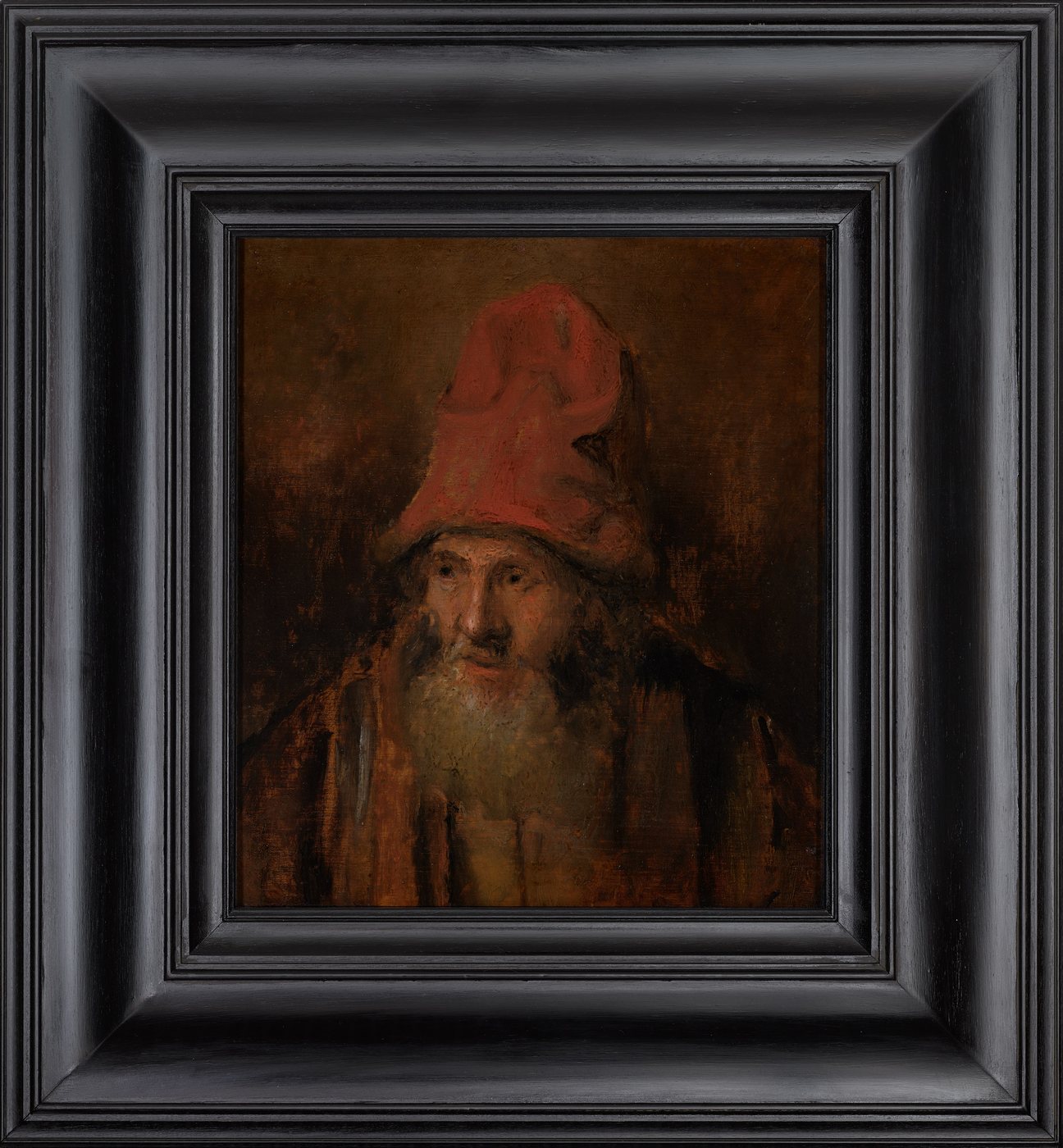
Tronie of a Man with a Tall, Fur-Edged Red Cap
- Oil on panel
- 22 × 19 cm
This small panel depicts the bust of an old man with a long grey beard and a striking red cap, set against a dark, neutral background. The figure is rendered frontally, the face built up with broad, direct brushstrokes, illuminated in strong chiaroscuro. The handling of the beard and cap is painterly and paste-like, while the facial features are summarily but effectively modelled. The lack of a detailed setting and the modest scale suggest the work was conceived not as a commissioned portrait, but as a study or tronie – a character study of a head or figure type rather than an identifiable individual, which became especially popular in the Rembrandt circle during the mid-seventeenth century. The motif of an old man with a red cap can be traced directly to Rembrandt van Rijn’s atelier practice and was widely adopted by his pupils, among them Karel van der Pluym.
Karel van der Pluym (1625–1672) was a Leiden-born painter who received his artistic training in the circle of Rembrandt van Rijn. While little documentary evidence survives regarding his apprenticeship, stylistic affinities between his paintings and drawings and those of Rembrandt’s studio strongly suggest direct exposure to the master’s methods. The 1650s were a formative decade for Van der Pluym, during which he developed an idiom closely aligned with Rembrandt’s workshop practice while beginning to articulate his own independent style.
The technical and stylistic evidence suggests that the present painting is best regarded as an early work by Karel van der Pluym. The panel’s vigorous brushwork, subtle pentimenti and warm tonalities correspond closely with other tronies attributed to Van der Pluym, while distinguishing it from the more mechanical repetitions typical of the broader Workshop of Rembrandt. The recent restoration has revived the intensity of the red cap, revealing its original vibrancy and the nuanced impasto that characterises its surface.
Provenance
- Belgium, private collection