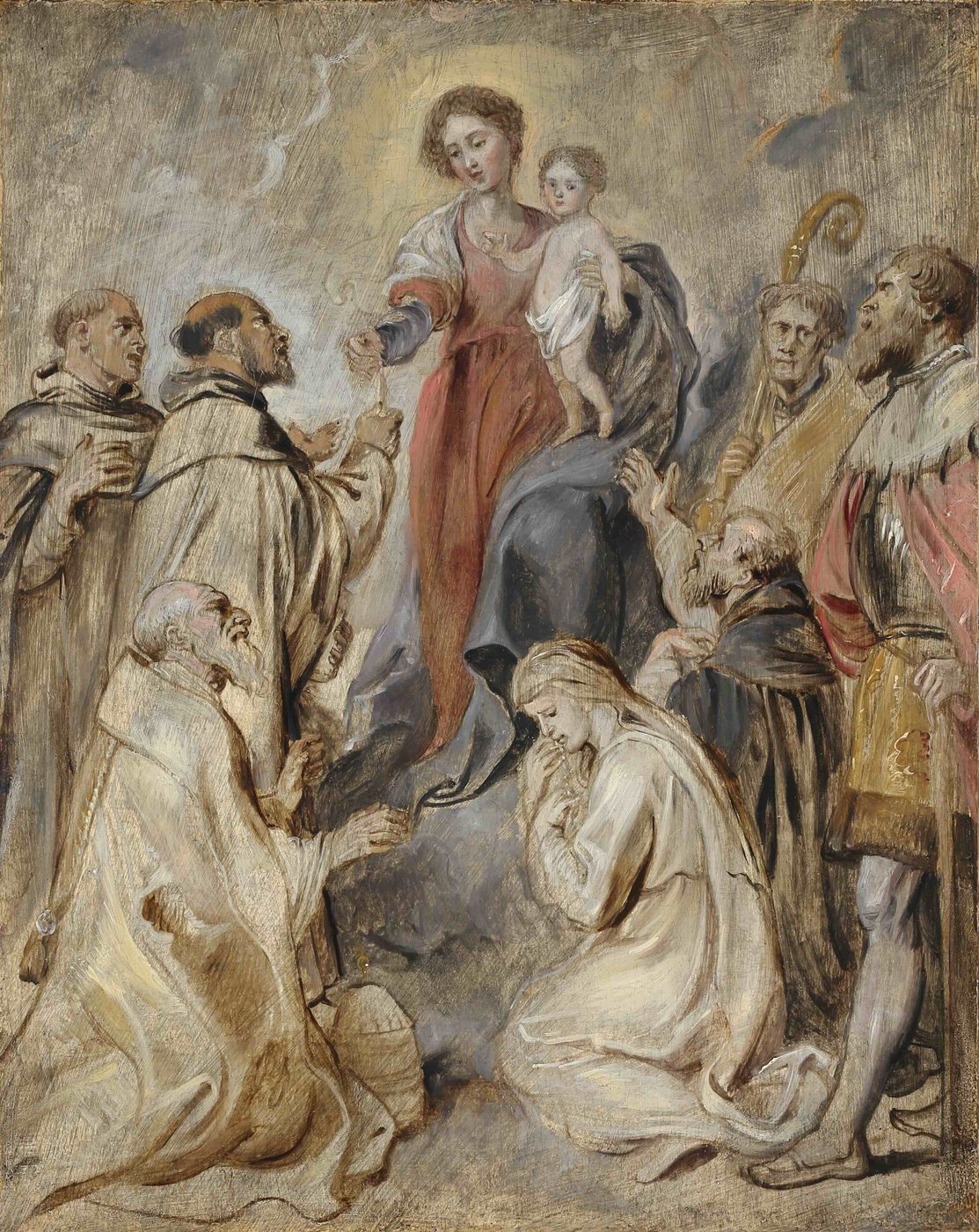
Peter Paul Rubens
Siegen 1577 – 1640 Antwerp
The Virgin and Child of the Rosary
- Oil on panel
- 42.8 × 34.3 cm
By the time Peter Paul Rubens (1577-1640) painted the present oil sketch around 1630/32, he was well over fifty years old, the western world’s undisputed number one painter, an international diplomat with a stellar reputation frequenting the royal courts of Europe, the personal friend of the continent’s rulers, who endowed him with tremendous commissions. Rubens did suffer from gout attacks and melancholy, but since his marriage in December 1630 – after having been a widower for four years – to the sixteen-year-old Hélène Fourment (1614-1673) we don’t hear so much about them for a while. Rubens was thus at the height of his powers.
A sketch and an altar piece
The recently surfaced painting here under discussion, last seen in public over forty years ago, is Peter Paul Rubens’ autograph oil sketch done in preparation for a large altar piece with the same composition executed by Rubens and his workshop, which is kept in the Pushkin Museum in Moscow since 1924. Both sketch and altar piece depict the Virgin Mary, with the Christ child standing on her lap, presenting a rosary to St Dominic and other saints. The fine, balanced composition exudes grandeur but maintains a sense of intimacy. Executed with admirable economy, using only red, ochre, black and white over a swift brown outline, and painted directly on the well visible imprimatura, the oil sketch – for such models Rubens himself used the Italian and Dutch terms ‘dissegno colorito’ and ‘schetsen’ – lays down all the essential parts of the larger painting. The final work deviates from its design in details, such as the slightly altered position of the Virgin Mary, who stands in the sketch while she seems seated in the altar piece, the likewise adjusted pose of the Christ child, and a few added attributes and elaborations. Given these differences, an engraving by Adriaen Lommelin (c. 1620-c. 1673) was surely done after the sketch, rather than after the altar piece.
The small panel served as the ‘canvas’ for Rubens’ creative process, as the scale model that he could show to his patrons, and as the basis for him and his assistants in the creation of the larger work, which was originally made for the Kluizekerk (church of the Cell, or Hermitage), the Dominican church in Lier, about fifteen kilometers southwest of Antwerp. Unfortunately, details about the commission to Rubens and the altar piece’s early history lack. It is only recorded for the first time in 1763, when it is described as standing on the Kluizekerk’s high altar. Soon after, the altar piece was sold to the Count of Cobenzl (1712-1770), from whom it was bought, in 1768, by Catherine the Great (1729-1796) for the Hermitage in St. Petersburg. After the Russian Revolution, the painting was transferred to the Pushkin Museum.
The Holy Rosary
While no contract between Rubens and the Dominican friars of Lier survives, contacts might well have been established through Rubens’ close friendship with the prominent Antwerp Dominicans Michael Ophovius (1570-1637) and Joannes Boucquet (1575-1640), patrons of Rubens who were both personally involved in the founding of the Dominican cloister in Lier in 1605, the latter even consecrating the cloister in 1612, reading the first mass in the Kluizekerk.
At any rate the theme of the Madonna with the Rosary was particularly Dominican. According to a fifteenth century legend that was introduced by the Dominican monk Alanus de Rupe (1428-1475), the order’s founder, the Castilian priest St Dominic de Guzmán (1170-1221) around the year 1208 experienced a vision of the Holy Virgin Mary at the Monastery of Our Lady of Prouille in the south of France. During this apparition Mary handed St Dominic a rosary, teaching him the associated prayers as a powerful devotional aid. The rosary, a necklace consisting of prayer beads with a cross, was to be used as an abacus for the reciting in set order of the Holy Rosary, a collection of devotional meditative prayers and hymns, Hail Mary’s, Our Father’s, Glory Be’s interspersed with fifteen mysteries, meditations on episodes in the life and death of Christ. The veneration of the Virgin Mary, the cult of the Holy Rosary, and its promoting among the faithful formed essential aspects of Dominican life, at the core of their spiritual existence. With Dominican communities spreading over Europe, the adoration of the Virgin of the Rosary became an emblematic theme in the art of the Counter-Reformation.
Rubens and Caravaggio
Not surprisingly, most of the figures surrounding the Holy Virgin and Child in the sketch and the altar piece are, judging from their clothing, recognizable as Dominicans. Before addressing their possible identities, it is important to point out that Rubens had a special affinity with the theme, beyond its importance to the Counter-Reformation. Around 1617-1619 he and a group of ‘liefhebbers’, a.o. the painters Jan Brueghel the Elder (1568-1625) and Hendrick van Balen (1573-1632), had spearheaded a successful effort to ascertain for Antwerp a masterpiece by Caravaggio (1571-1610), the Madonna of the Rosary now in Vienna. Bought by Rubens cum suis for 1800 florins from the painter Abraham Vinck (1574-1619) in Amsterdam, the painting was donated to the Antwerp Dominicans’ St. Paul’s Church. There it became the proud capstone of a recently completed cycle of fifteen paintings by a number of Antwerp masters, including Rubens, Van Balen and Frans Francken the Younger (1581-1642), each depicting one of the fifteen Mysteries of the Rosary, as seen in a painting of the church’s interior by Pieter Neeffs the Elder (c. 1578/90-1656/61) where Rubens’ Flagellation hangs second to the right of the Caravaggio.
Caravaggio’s painting depicts the Holy Virgin Mary with the Christ child on her left knee, as she instructs St. Dominic to distribute rosaries among the clamoring faithful. To the left, the Dominican friar St. Peter Martyr, a head wound as his attribute, points out the origin of all grace, the infant Jesus. Rubens must have felt great satisfaction about his achievement of getting the Caravaggio to Antwerp. And clearly, he took inspiration from it, as is evidenced by his now lost Madonna of the Rosary with the Archdukes altar piece, executed c. 1621 for the royal chapel of the Dominican church in Brussels. Rubens’ original painting was lost in the fires of the French bombardment of Brussels in 1695, but its appearance – showing Mary handing out the rosary to St. Dominic and a group of saints, among them the Dominican St. Thomas Aquinas (to St. Dominic’s left), and to the right St. Francis of Assisi and Catherine of Siena, recognizable from her attributes, the thorned crown and the heart – is known from copies.
Who’s who
The lasting impact of Caravaggio’s Madonna of the Rosary on Rubens is likewise palpable in the present oil sketch, with its strongly related subject and evident compositional parallels. As did Caravaggio, Rubens construed a triangular composition with saints grouped around either side of the enthroned Virgin and Child, adding dynamic by positioning Mary half seated, half standing on her right leg. The chosen setting, though, deviates from Caravaggio’s, as Rubens renders the scene, in accordance to St. Dominic’s legend, as a divine celestial apparition. The radiant Mary, whose soft and serene face echoes Rubens’ brilliant drawing Young Woman Looking Down of about 1628, holds the Christ child standing on her knee, as she descends to St. Dominic and his entourage with a fluttering filmy scarf on a heavenly cloud. As St. Dominic, holding a gospel book in his left hand, gracefully accepts the rosary, another friar behind him, also wearing a Dominican habit, reaches out in worship. He must be St. Thomas Aquinas (c. 1225-1274), who likewise stood behind St. Dominic in Rubens’ Madonna of the Rosary with the Archdukes. No doubt the most distinguished Dominican besides St. Dominic himself, Thomas Aquinas was considered one of the western world’s greatest theologians. To accentuate the divine light of his intellect, he was often depicted with a star or sun frontally on his capuche. Clearly visible in the Moscow altar piece, Rubens in the sketch merely hinted at it at the top of Thomas’ fingers.
The kneeling man looking up with his hands spread in grace must be a pope, given the papal tiara in front of him. Waagen, the first to present an identification of the figures in 1864, incorrectly assumed him to be Gregory the Great (c. 540-604), but since Rooses (1886) he has always been identified as the Dominican Pope Pius V (1504-1572). Pius’ papacy was known for its strong stance against heresy and its restoring of discipline and morality in the Catholic Church. As such, he became synonymous with the Counter-Reformation. Pius’ dedication of the victory of the Holy League (a coalition of Catholic powers arranged by him) against the Ottoman Empire in the infamous Battle of Lepanto (1571) – a major moral and symbolic triumph for the Roman-Catholic world – to the Virgin of the Rosary, and his subsequent establishment of the Feast of Our Lady of the Victory, soon renamed Feast of Our Lady of the Rosary (7 October), explains his presence. Pius’ characteristic facial profile, a bald head with pronounced forehead wrinkles and a hooked nose, was rendered by Rubens with flawless accuracy and vivacity. Kneeling next to Pius while embracing the rosary and Mary’s left foot is a female saint, recognized by Waagen as the Carmelite nun and mystic St. Teresa (1515-1582), but otherwise unanimously identified as the lay Dominican St. Catherine of Siena (1347-1380), one of the great mystics of her time, who experienced visions of the Virgin Mary. In the altar piece she wears one of her identifying attributes, the thorned crown. Regularly encountered among the saints receiving the rosary within the theme’s pictorial tradition – e.g. the Madonna of the Rosary with the Archdukes – Rubens depicted her blissful adoration here with barely more than a few brushstrokes, far more striking in comparison to the final altar piece.
The identity of the three saints grouped to the right has been disputed. The bearded Dominican keeping his hand at his chest, his right arm stretched towards the Virgin and Child, has been said to be the Dominican friar St. Peter Martyr (1205-1252). Despite a lack of attributes, Mees in 1991 alternatively proposed to identify him as the above mentioned Alanus de Rupe (1428-1478), the friar responsible for spreading the legend of St. Dominic’s apparition. Alanus founded the first Fraternity of the Holy Rosary, in Douai, making him a quintessential figure in disseminating the worship of the Virgin of the Holy Rosary in northern France and the Netherlands. While the suggestion is attractive – the Dominicans in Lier would have certainly felt strong adherence towards Alanus – and should not be disregarded, the pictorial tradition consistently depicts Alanus beardless. Moreover, given Rubens’ reliance on Caravaggio’s Madonna of the Rosary, and the similar right-sided position in that painting of St. Peter Martyr, who likewise has a beard and stretches his right arm to the Virgin and the Christ Child, might argue in favor of the traditional identification.
The bearded man on the far right, leaning on a stick and dressed in an ermine cloak, a cuirass and embroidered tunic – not a Dominican – is often thought to be a king. Waagen perceived him as ‘Ferdinand’, presumably Ferdinand III of Castile (c. 1200-1252), Knipping in 1974 suggested St. Louis IX of France (1214-1270). Rooses (1886), and others in his slipstream, assumed he was St. Ladislaus, king of Hungary (c. 1040-1095), ‘known for his devotion to the rosary’. In the company of the Dominican saints, though, the inclusion of Ladislaus seems random. A convincing alternative was put forward in 1980, when it was stated that the man was, in fact, St. Gummarus (664-c. 714). In contrast to the other saints depicted, Gummarus did not have a connection to the rosary. He was, however, the patron saint of Lier, and as such he did have a unique relationship with the city, and the Kluizekerk, specifically. A Lier native, Gummarus lived for a time as a knight – hence his clothing – and later retired as a hermit.
A notably evocative episode in Gummarus’ life was the so-called miracle of the tree. When Gummarus and his suite once spent the night in a field, he decided to cut down a tree that stood in the way. This severely angered the farmer who owned the tree. Admitting his error, Gummarus had the tree placed back on the stump, took off his girdle and bound it around the trunk. The next day the tree appeared unscathed, to the amazement of the joyous owner. At the location of this miracle a hermitage was built (in Dutch: kluis), in time becoming Lier’s Kluizekerk, its choir constructed on the exact spot where once the tree had grown. To commemorate the miracle, a wrought-iron tree with Gummarus on top was placed in the choir around 1475. Rubens’ inclusion of St. Gummarus in his sketch and altar piece was thus completely justified, and geared towards the specific location. A painting by Rubens’ Antwerp colleague Frans Francken the Younger, painted in 1627 for Lier’s nearby St. Gummarus Church, depicts Gummarus performing his miracle. Given the resemblances in Gummarus’ pose and clothing, Francken’s effort might have well served Rubens for inspiration.
The last to be identified is the saint standing between the Holy Virgin and St Gummarus, holding a crozier, his position and tilted head echoing Caravaggio’s St Peter Martyr (with whom he clearly is not identifiable). At least since Rooses (1886) he has been recognized by most authors as St. Isidore of Seville (560-636). In 1940 Knipping, as an exception, presented him as St. Antoninus of Florence (1389-1459), revered Dominican bishop of Florence, an identification embraced by Mees, who pointed out the tonsure, supposedly making him a likely Dominican, whereas Isidore of Seville had nothing to do with this order. Although presumably a better fit, the inclusion of Florence’s bishop nonetheless seems arbitrary. A possible alternative is proposed here. The saint with the crozier could be the hermit St. Rumbold (d. c. 655), patron saint of nearby Mechelen and St. Gummarus’ dearest friend. After one especially inspired meeting on the border of their mutual lands, the befriended neighbor saints planted their staffs into a dead tree, after which the tree came back to life and twigs and leaves miraculously started to sprout from their staffs.
We come across a depiction of this wondrous meeting in a painting attributed to Colijn de Coter (c. 1450-1539/40) in Mechelen’s St. Rumbold Cathedral. One of a cycle of 25 paintings, other works belonging to this cycle depict St. Rumbold wearing a tonsure and carrying a staff, just as the saint in the present sketch and the Moscow altar piece. The argument gains further weight considering the undeniably intentional glance of the saint with the staff – both in the sketch and in the altar piece – at St. Gummarus. Never addressed until now, this glance must emphasize a connection. All considering, the crozier saint’s presence might in fact be motivated not so much by his devotion to the rosary (as is the case with the other saints, Gummarus excepted), but rather by his profound friendship with his neighbor, Lier’s patron saint Gummarus, the reason that he looks at him instead of at the Madonna and Child, as all the others do. Moreover, the miracle of the dead tree coming back to life and the leaf-growing staffs – arguably referenced by the crozier – closely resembles, and could comfortably be merged with, the miracle of the tree growing back performed by Gummarus, the very foundation of the Kluizekerk, the main reason for Gummarus’ presence in the group.
Treatment and dating
Until the surfacing of our oil sketch in 2024, the work had not been restored for at least a near century. Rubens expert Julius Held (1905-2002) knew the painting firsthand, at the latest since 1942, the year of the Schaeffer & Brandt exhibition for which he, a New York professor of art history since 1937, wrote the introduction. Having published the work in 1947, Held, in his seminal The Oil Sketches of Peter Paul Rubens : A Critical Catalogue (1980) again underlined Rubens’ authorship, but observed areas of old overpainting around the face of the Virgin, the Christ child, and the face of saint Rumbold. Most of all, thick layers of dirt and old, yellowed varnish seriously impeded the view. The recent treatment was thus long due, and effected a transformation, the painting’s fatigued appearance giving way to its once intended clarity. As noted by Held, the face of the saint with the crozier (Rumbold), in particular, turned out to be covered by disturbing ochre overpaint by a later hand, the removal revealing the plain quality of Rubens’ outlines. The result allows us, for the first time since the work’s recorded history, to fully appreciate Rubens’ crisp tonality, his light-fingered brushstrokes, and the velocity and efficiency of his creative process.
The Moscow altar piece must have been painted soon after the creation of the sketch. As proposed by Rooses in 1886, both works are usually dated around 1630/32. Affinity with other oil sketches from the period, likewise done in preparation for altar pieces, such as the Assumption of the Virgin in the Yale Art Gallery, datable somewhat later to 1635/38, or the Coronation of the Virgin oil sketch in the Metropolitan Museum of Art, New York, datable to c. 1630/33, indeed point to a creation in the early 1630s.
Provenance
- Probably sale London, Henry Phillips, 2-3 February 1804, lot 149 (this lot: 3 February)
- Paris, Galerie Sedelmeyer, by 1897, by whom sold to
- New York, collection Edward Rathbone Bacon (1848-1915)
- Paris, art dealer Eugène Fischhof (1853-1926)
- The Hague, collection Dorus van Germsen (1871-1931) / Galerie Huys van Johan de Witt, until 1930
- New York, art dealer Julius H. Weitzner (1896-1984), by 1930, at least until 1936
- Princeton, collection Edward Leavitt Howe (1870-1952), bought from the above in 1942 (on consignment with Schaeffer & Brandt, Inc. between 1943 and November 1945); by descent to his wife, Adelaide Foster Howe (1901-1991), Princeton (NJ)
- Sale New York, Christie's, 18 January 1984, lot 163
- United States, private collection, until 2024
Literature
- M. Rooses, Rubens’ leven en werken, Amsterdam/Antwerp/Ghent 1903, p. 543 (French ed., Paris 1903, idem.)
- J.B. Townsend, W. Stanton Howard, J. Getz, Memorial catalogue of paintings by old and modern masters collected by Edward R. Bacon, New York 1919, p. 144, cat. no. 179
- W.R. Valentiner, An exhibition of sixty paintings and drawings by Rubens, exh. cat. Detroit, Detroit Institute of Arts 1936, n.p., cat. no. 50 (loaned by Julius H. Weitzner, New York)
- A selection of paintings, exh. cat. Julius H. Weitzner, Inc., New York 1936, n.p., cat. no. 8, ill.
- L.M. Nash, Peter Paul Rubens : Loan Exhibition for the Benefit of the United Hospital Fund of New York, exh. cat. New York, Schaeffer & Brandt, Inc. 1942, n.p., cat. no. 22
- W.R. Valentiner, ‘Rubens Paintings in America’, in: The Art Quarterly 9 (1946), pp. 153-168, p. 163, no. 92
- J.-A. Goris, J.S. Held, Rubens in America, New York 1947, p. 34, cat. no. 55
- E. Larsen, P.P. Rubens : with a complete catalogue of his works in America, Antwerp 1952, pp. 217-218, cat. no. 72
- J.S. Held, The Oil Sketches of Peter Paul Rubens : A Critical Catalogue, 2 vols., Princeton 1980, 1, pp. 522-523, cat. no. 386; 2, pl. 377
- L.J. van Nueten, R. van Wassenhove, Catharina van Siëna 1380-1980, Leuven 1980, p. 169
- J.S. Held, ‘New Oil Sketches by Peter Paul Rubens’, in: The Burlington Magazine 129 (1987), pp. 572-583, pp. 573, 583 (Appendix)
- M. Jaffé, Catalogo Completo : Rubens, Milan 1989, p. 328, cat. no. 1050, ill.
- M. Mees, ‘Van Kluis naar Hermitage : Het Rozenkransschilderij van P.P. Rubens uit de Kluizekerk van Lier’, in: Lira Elegans : Jaarboek Liers Genootschap voor Geschiedenis 1 (1991), pp. 109-154, pp. 124-126, fig. 4
- F. Healy (B. Vanoppen, ed.), The Holy Trinity, The Life of the Virgin, Madonnas and The Holy Family : 1. The Holy Trinity and The Life of the Virgin (Corpus Rubenianum Ludwig Burchard IV/1), 2 vols., London/Turnhout 2024, 1, pp. 287, 288; 2, fig. 334
- To be included in B. Vanoppen, The Holy Trinity, The Life of the Virgin, Madonnas and The Holy Family: The Holy Family (Corpus Rubenianum Ludwig Burchard IV/3)
Exhibited
- Detroit, Detroit Institute of Arts, An Exhibition of Sixty Paintings and Drawings by Rubens, 1936, no. 50
- New York, Schaeffer & Brandt, Inc., Peter Paul Rubens : Loan Exhibition for the Benefit of the United Hospital Fund of New York, 1942, no. 22 (loaned by Howe)