Peter Paul Rubens
Siegen 1577 – 1640 Antwerp
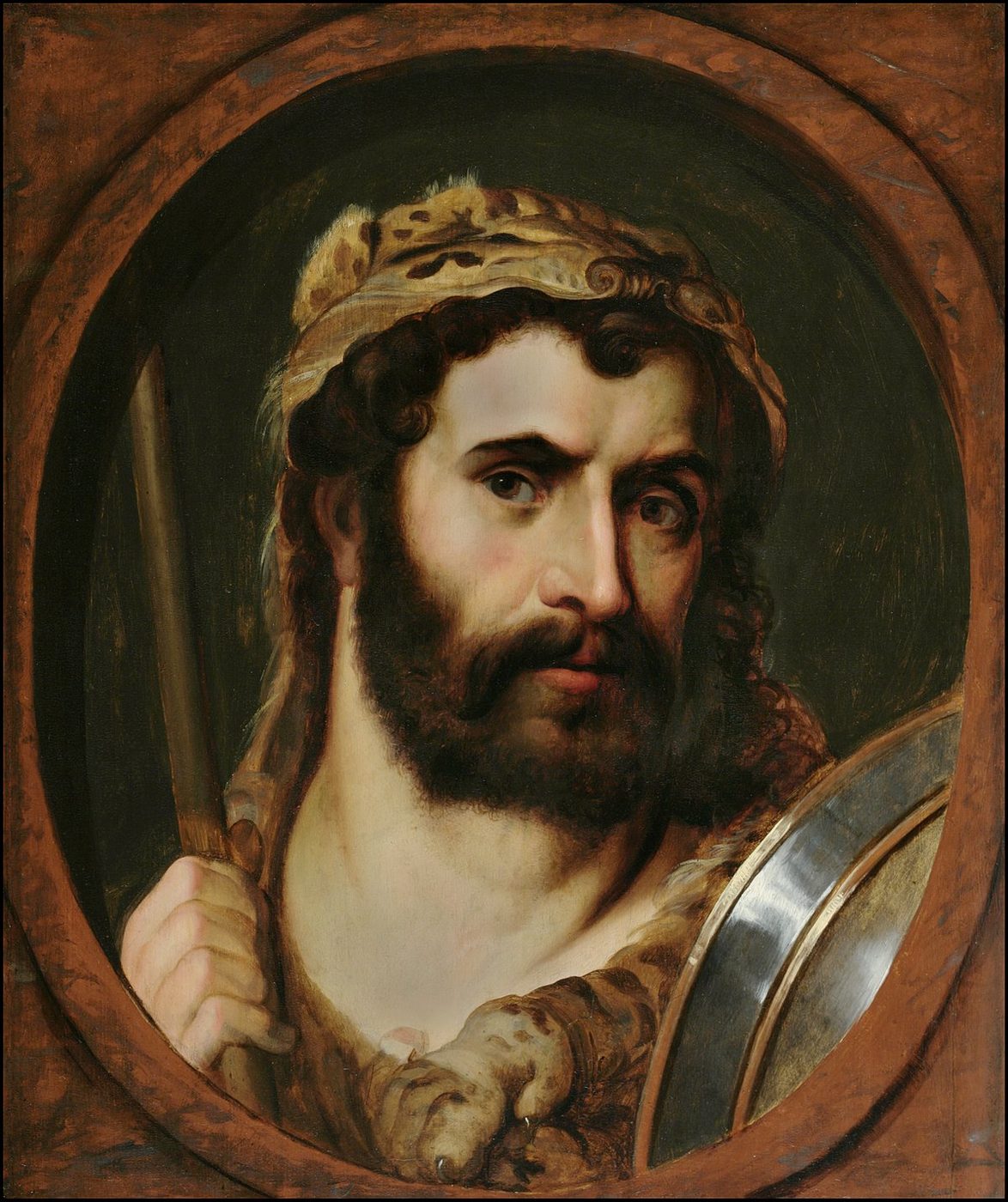
Hercules as a Gladiator
- Oil on panel
- 65.5 × 54.4 cm
Datable to the very end of the sixteenth century (c. 1599–1600) on the basis of dendrochronology and stylistic analysis, this well-preserved panel marks the close of Rubens' youth and the beginning of his mature career. It is loosely related to the ambitious series of Roman emperor portraits the young Rubens produced around 1598–1600, yet stands apart through its exceptional quality and inventive iconography — combining the attributes of Hercules, a Roman gladiator of the Hoplomachus type, and possibly the emperor Hadrian. Long mistaken for a portrait of the emperor Commodus dressed as Hercules, the identification has since been revised: the sitter's features do not match the securely documented Commodus portrait in the Stuttgart/Phoebus series. The panel is discussed at length by Koenraad Jonckheere as an outstanding example of the young Rubens "thinking" through paint — testing physiognomy, gesture and allegory years before his Italian period.
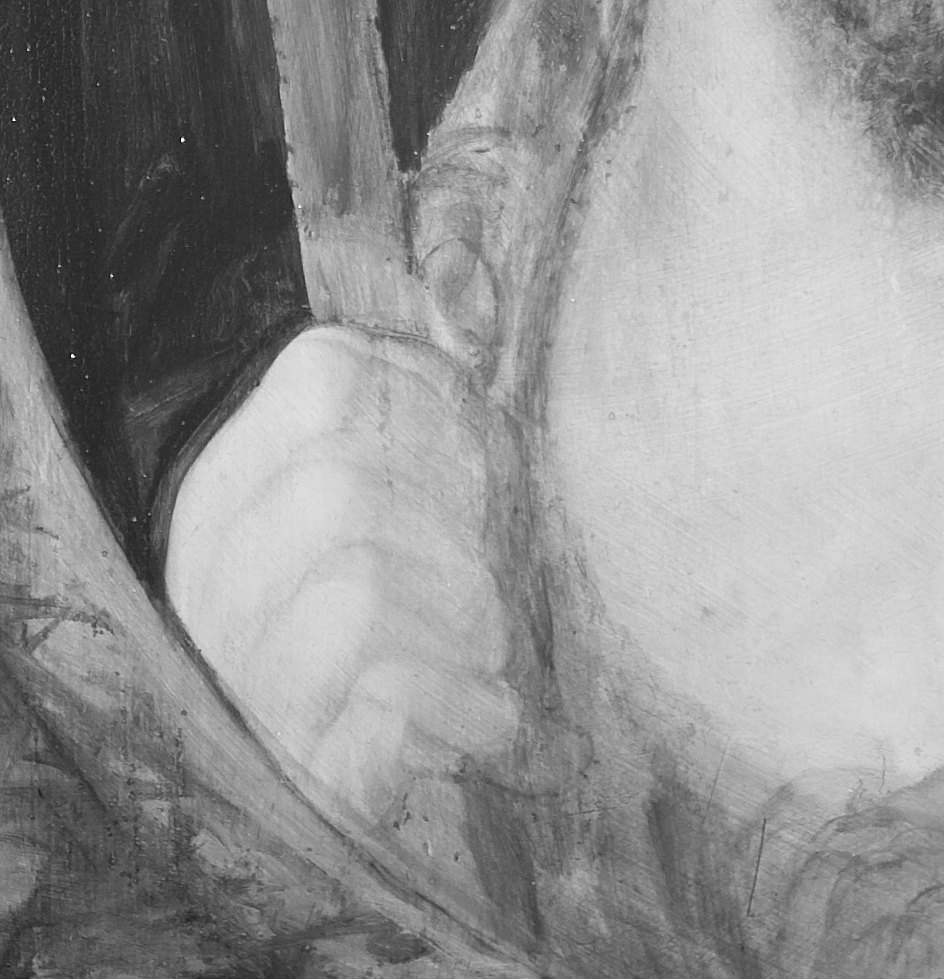
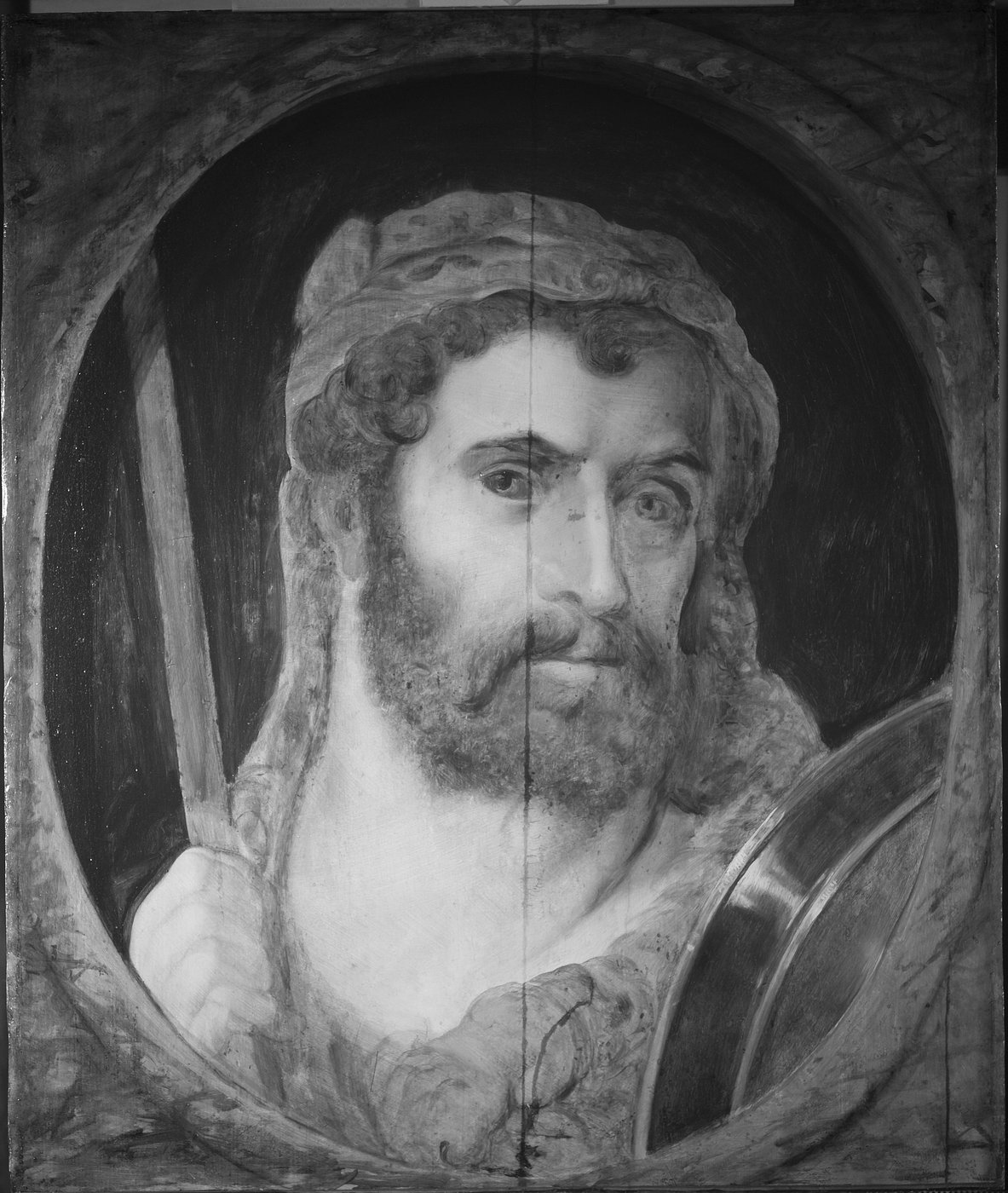
Infrared reflectography reveals a remarkable pentimento in the hand gripping the club: Rubens changed the position of the thumb while painting, and its first placement can still be traced beneath the final paint layer. Such corrections, made directly on the panel, are a precious testimony of the master’s hand at work – an artist correcting himself as the composition took shape.
Provenance
- Belgium, with an aristocratic family for several generations
- New York, Jack Kilgore & Co, by 2010, by whom sold to
- New York, Leiden Collection, until 2023
Literature
- P.C. Sutton, Peter Paul Rubens, Emperor Commodus as Hercules and Gladiator, circa 1597-99, unpublished factsheet Jack Kilgore & Co., New York 2011
- P.C. Sutton, Peter Paul Rubens : Portrait of the Emperor Servius Sulpicius Galba (3 BC – 69 AD), Amsterdam, Salomon Lilian Dutch Old Master Paintings 2014, pp. 4-5, fig. 1
- K. Jonckheere, Portraits after Existing Prototypes (Corpus Rubenianum Ludwig Burchard XIX/4), Turnhout/London 2016, pp. 85, 102, cat. no. 35a, fig. 139
- I. van Tuinen, ‘Emperor Commodus as Hercules and as a Gladiator’ (2017), in: A.K. Wheelock Jr., L. Yeager-Crasselt (eds.), The Leiden Collection Catalogue (3rd ed.), New York 2020
- L. Yeager-Crasselt, ‘The Leiden Collection and the Dutch Golden Age’, in: P. Lyubimova (ed.), The Age of Rembrandt and Vermeer : Masterpieces of The Leiden Collection, exh. cat. Moscow, The Pushkin State Museum of Fine Arts, St. Petersburg, The State Hermitage Museum 2018-2019, pp. 16-27, p. 18, note 12; pp. 28-33, p. 29, note 12
- L. Yeager-Crasselt, ‘The Leiden Collection and the Dutch Golden Age’, in: B. Ducos, L. Yeager-Crasselt (eds.), Rembrandt, Vermeer and the Dutch Golden Age : Masterpieces from The Leiden Collection and the Musée du Louvre, exh. cat. Abu Dhabi, Louvre Abu Dhabi 2019, pp. 24-31, p. 26, note 10
- A.T. Woollett, ‘Toward a living past: Rubens and the antique Triumph’, in: A.T. Woollett, D. Gasparotto, J. Spier (eds.), Rubens : Picturing Antiquity, exh. cat. Los Angeles, J. Paul Getty Museum 2021-2022, pp. 70-84, p. 75, and p. 106, cat. no. 20, ill.
- J. Wood, B. Schepers, in: E. McGrath, B. Schepers, B. Vanoppen (eds.), Mythological Subjects : Hercules to Olympus (Corpus Rubenianum Ludwig Burchard XXI/2), 2 vols., Turnhout/London 2022, 1, pp. 106-107, note 32
Exhibited
- Wellesley (MA), Davis Museum at Wellesley College, on loan 2016-2017
- Shanghai, Long Museum, 2017-2018
- Los Angeles, J. Paul Getty Museum (Malibu, Getty Villa), 2021-2022, no. 20